
Around about Christmas a tiny bird took flight from the top of a thorny bush. It flew north. It flew into another bush, foraging about low down in the undergrowth. It caught and ate a few spiders, hopped to the top and headed to another bush, again North.
That was the beginning of one of the most epic journeys any animal will ever undertake. The bird had no name for the parched sandy ground where the thorn bushes were thinly scattered. We’d call it something like Namibia or Botswana. Its next few hops grew longer and longer. With favourable nighttime breezes it drifted along in the cool, and it would find a thorny bush as the sun rose. It would rest and eat until the sun set and then hop off again, and north. It didn’t know it was Christmas when it first hopped north. It’s a restless bird ever on the move. It feeds by day and flies by night. It likes to be in the place where days are much longer than the nights. As soon as the days get a bit shorter it turns and follows the sun. Every flight before that first northbound one was southbound, and had been ever since it was able to fly.
As it headed over Angola the days and the nights grew more equal in length. So it took to spending long hours flying, covering more ground. As it passed through the vast jungles of the Congo basin the days and the nights were exactly the same.
It covered huge distances in the dark, completely unseen soon the jungle gave way to desert, through Central Africa and then the vast sandy waste of Chad.
During the time when the days and nights were more or less equal it was flying through jungle. There was plenty of food, the tiny insects and spiders it fed on. It knew where to look and it knew what to look for. Even though it had only been this way once, when it was heading south.
Because it got to the Kalahari it had found out where to find food and memorise it backwards. Those that didn’t learn didn’t make it. There were hundreds and hundreds of birds doing this journey, all driven by the movement of the planet around the sun and the pull of the moon. Many didn’t make it.
And now as the days grew long and the nights short it entered into the most inhospitable landscape you could imagine. There were vast distances between any vegetation. A lush oasis would see hundreds of birds briefly land, eat and refuel and fly on again. Always north and often during the heat of the day. There was nowhere to rest, not in Chad or Libya for vast distances that took a lot of time to cross.
Now they came to the sea. The Mediterranean coast.
Most of them would be funnelled together, following the coast until there was nowhere left and then from the Northernmost point of Nabeul governate the set off under a clear sky over an ocean with nowhere to stop and no food to eat.
They were headed for Capo Boeo.
The lucky ones got a clear run. Sometimes a heavy fog would disorient them and they’d never see land again. Sometimes a storm would blow them far off course. They’d maybe land on an island, maybe Isola de Favignana, or Isola de Pantelleria. A disaster too, unless they could rapidly learn where to find shelter and what food was available.
If they were really unlucky they’d end up in Malta and almost for the first time since they left the Kalahari desert humans were aware of them. And they would try and trap them and shoot them as a sign of their masculinity. Which they so clearly display by taking on such a fearsome quarry as a tiny brown warbler exhausted after 7,000 kilometres of flying in the last 6 weeks 7,000 more since they were last in this part of the world 3 months earlier.
They’d recalibrate their compass and head off on a new bearing until they picked up their route again.
Fortunately Italy is much more hospitable and they can feed and rest as they travel up the length of the country
As they hit the foothills of the alps they swung towards the setting sun and crossed the Loire and the Massif Central before arriving at the Point des Groins. Now as the spring equinox had passed they were able to cross the English Channel.
They dropped down into the garden of the bird observatory on Portland bill.
And a Marshian noticed their reported arrival. They were on their way home.
You see last June on Fobney marsh this bird hatched at the base of a Hawthorn by footpath 6, between the boardwalk and the branch line. It left that bush and headed south not stopping until it met with the San people. The Marshian had never met the San. He knew they lived very very close to the land. So close they needed for nothing. They knew where to find food and water and shelter in the vast Kalahari. Ever since the Marshian first found out about them he was fascinated by them, one of the last races of humans pretty much unaffected by colonisation or the Industrial Revolution
The only link between him and those people who have influenced him more than any other is this tiny brown bird.
When he first came to the marsh almost 4 decades ago he found that the Whitethroats arrived on the marsh every year on April 22nd.
There were only a handful of them back then but as the habitat became more scrubby the Whithroats thrived.
And then one year the Marshian and his 10 year old offspring found one on the track they called the Bump bumps on the 19th of April. This was so remarkable it was discussed as the whole family sat down for tea. And it was the 10 year old who mentioned it.
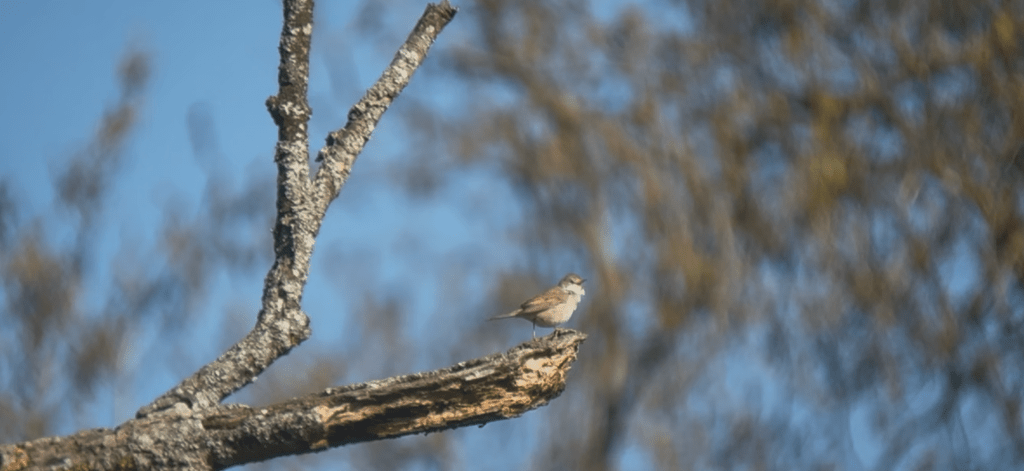
The offspring have long since grown up but the Marshian hasn’t. He still sits in the marsh waiting patiently for the first Whitethroat to sing its song. He will then let all his friends know that the bird has returned having flown 18,000 kilometres Since it fledged 9 months ago.
Because having left Portland bill it is on the very final leg of its journey. It’s is now home on Fobney marsh where it will find a mate, build a nest, raise a family and then one day it will hop south from the top of a thorny bush. And it will head south as the days back shorten to nothing. It will pass unnoticed until a woman out collecting food for dinner spots one and tells all her friends. I don’t suppose she knows its other home is the marsh.
 Rural Reading