
“I’m just taking the dogs for walk” ….
A quarter of a mile through the suburbs. That’s what most dogs near me get it seems. That was just the start of our walk, that’s all it takes for me to get to the meadows.
The bed of the old railway is where I leave the town behind, passing the urban fringe of unwanted sofas, sweet wrappers and drink cans. The track is covered in mirabelles, glowing gold in the early light, they’re delicious, and I’ll be back this way to collect some later.

There’s a kink in the path which is a kind of portal, beyond I could be miles out of town, but for the glimpse of the high rise not that far away. Before the kink it’s the edge of town. Beyond it’s the meadows.
I’m in a tunnel of trees, almost all of which have sprung up in the time I’ve known this track. Nobody’s planted anything, the birds have done it for free.
There are little gaps which offer glimpses of the fields either side.
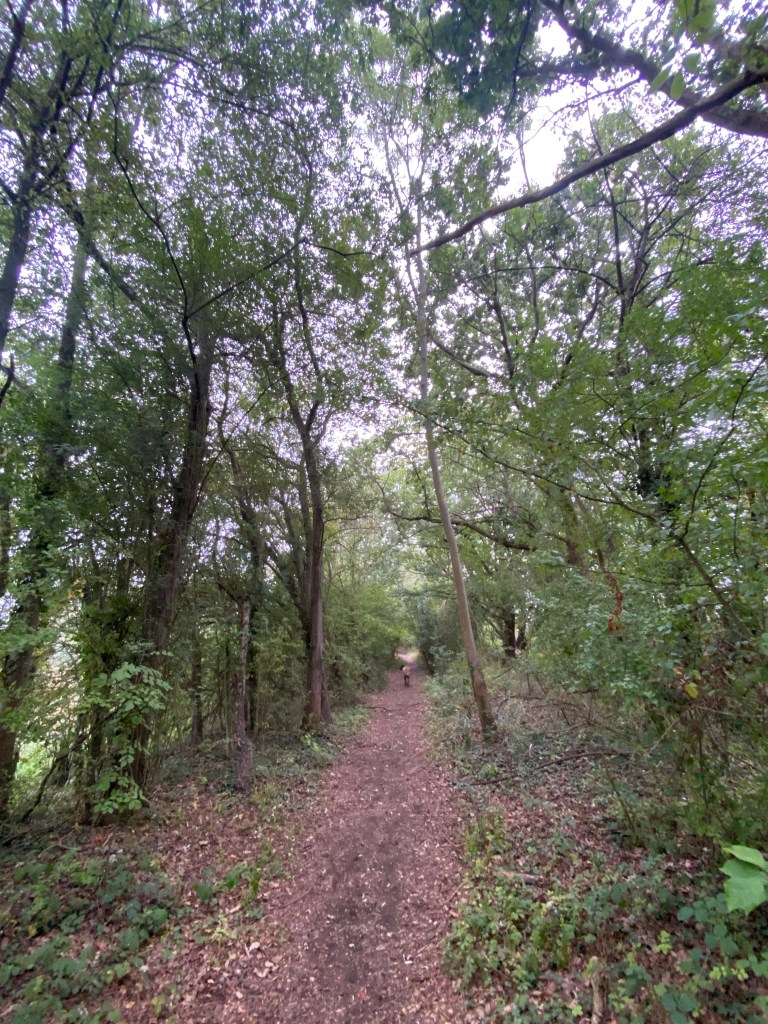
It’s quiet now, but for the cackle of magpies and the squeaking of tree creepers.
I can hear chiff chaffs calling in the branches overhead. I can’t see them though. They’re foraging among the leaves.
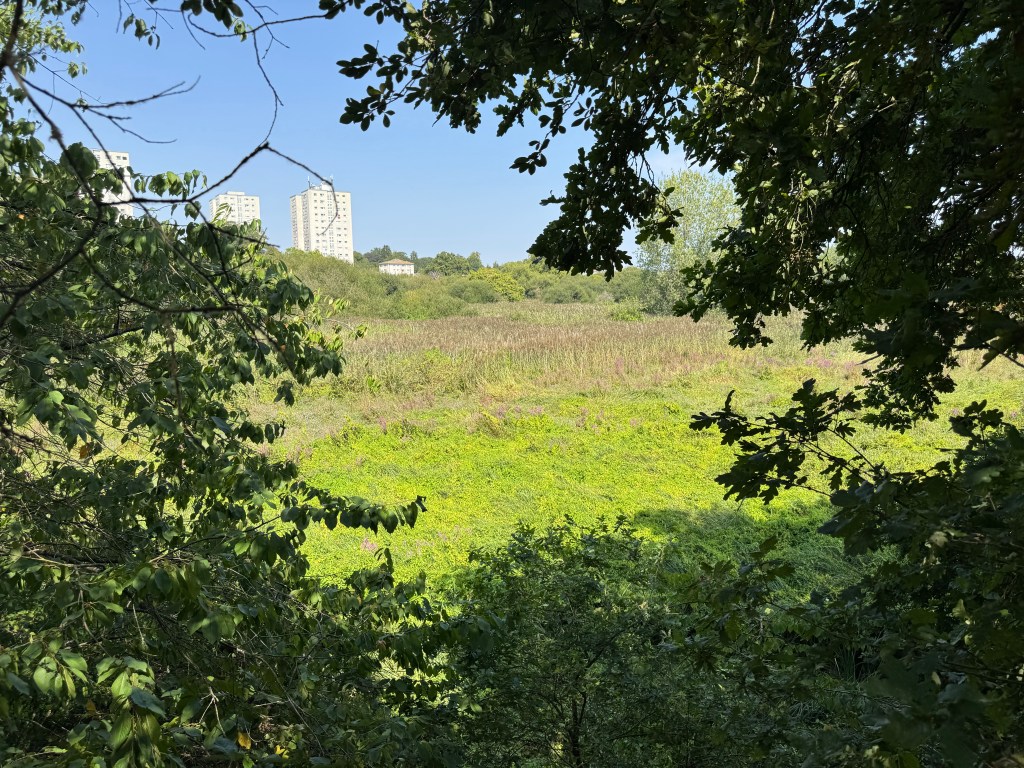
The wind makes shapes with the Reed bed below, the dark flower heads waving above the mass of leaves and stems. There’s a magnificent oak tree in the middle of the sea of swaying grass, which are almost 10 feet tall. Getting to it is pretty much impossible. Just below the tower blocks is a place so wild nobody ever goes there.
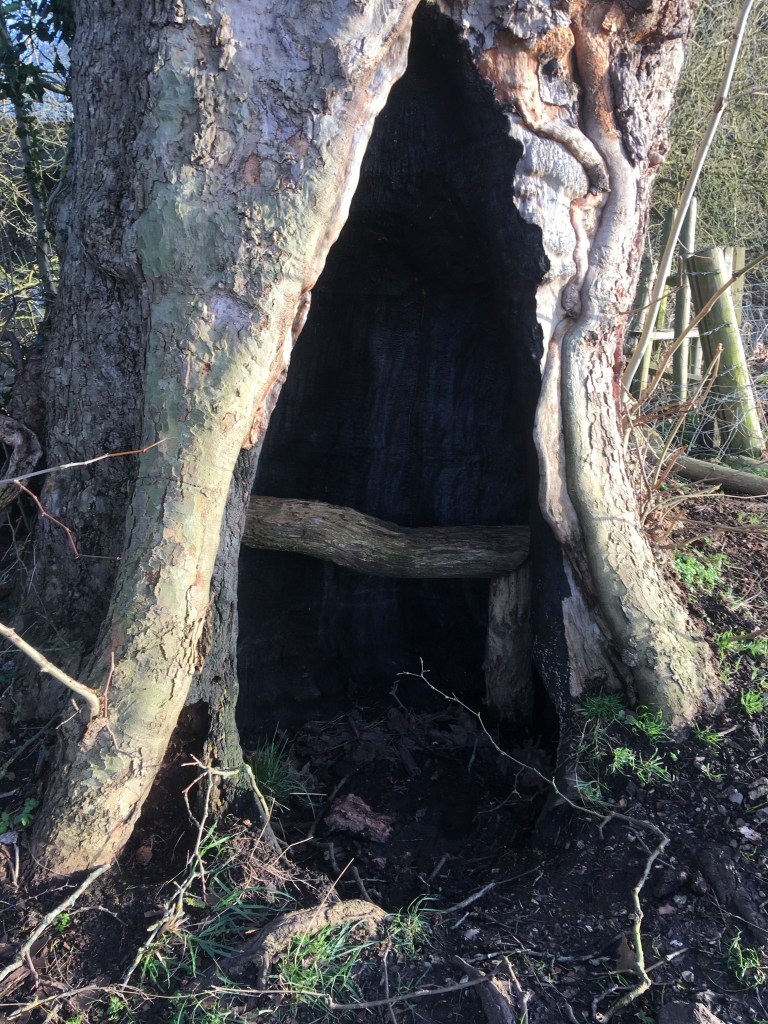
Just as I cross the Holy Brook the meadows open up to my right and I slip down the embankment to the river bank. Here is one of the most magnificent trees in my world, an ancient London Plane. It has huge hole where two people can fit. People have lit fires in it many times. I made a bench to go in it once, so I could sit inside the burnt out hollow when the rains fell. Someone burnt it. I was upset, the tree didn’t seem to care. I’m not sure how I would know if it did, but it’s still growing well. 350 years old, one of the oldest of its type in the world.
Now I’m in the marsh. It’s not easy to walk through here but it is worth it. There’s no path, just a line worn through the grass. All winter it’s too wet and all summer it’s too overgrown, as it is now. For a few weeks after the flood recedes and before the flora bursts out from the soil it’s walkable. So I walk here often and create a well worn path. It was easy enough to follow then but not now. The plants are now so tall they smother the path, and it’s difficult to see where I walked before. Brambles reach out from the hedgerow and thistles scratch at my legs.
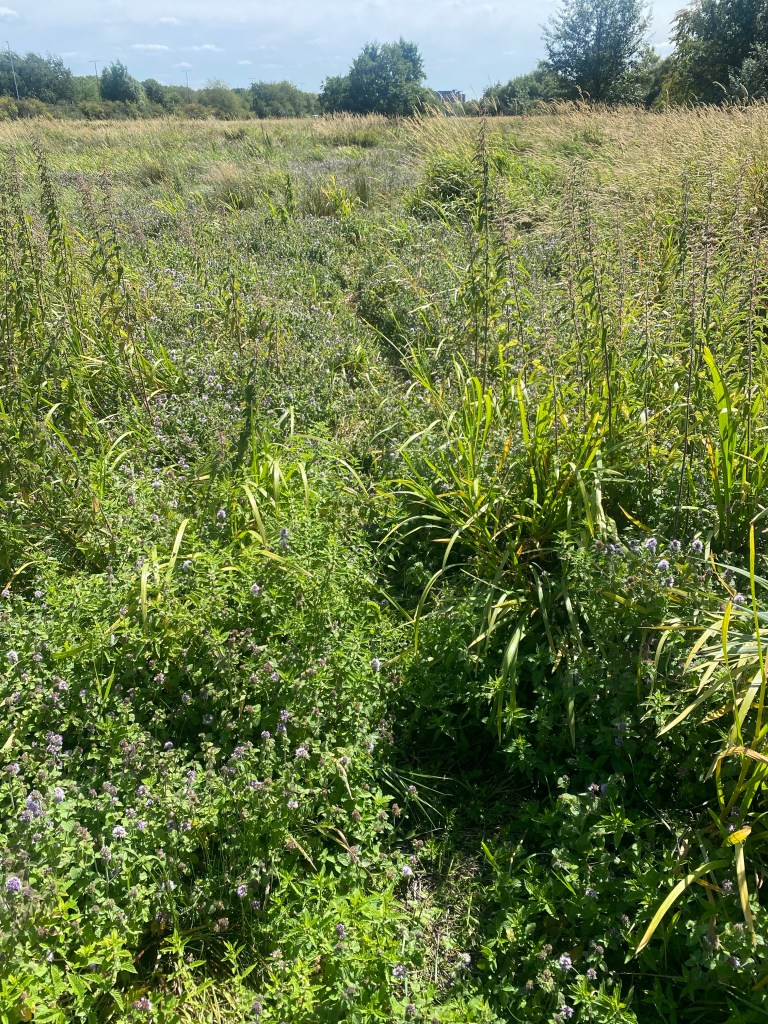
It’s also soaking wet. The sun has yet to dry out the grass from the overnight dew and my feet are sodden in no time.
But this field, oh my what a treasure. There are huge banks of watermint covered in pink flowers. The smell of freshly brushed teeth surrounds me. The faint sound of bees buzzing about the flowers is accompanied by the occasional chirp of a cricket. There’s Fleabane and ragwort and thistles and loosestrife and hemp agrimony to mention some of the many flowers.
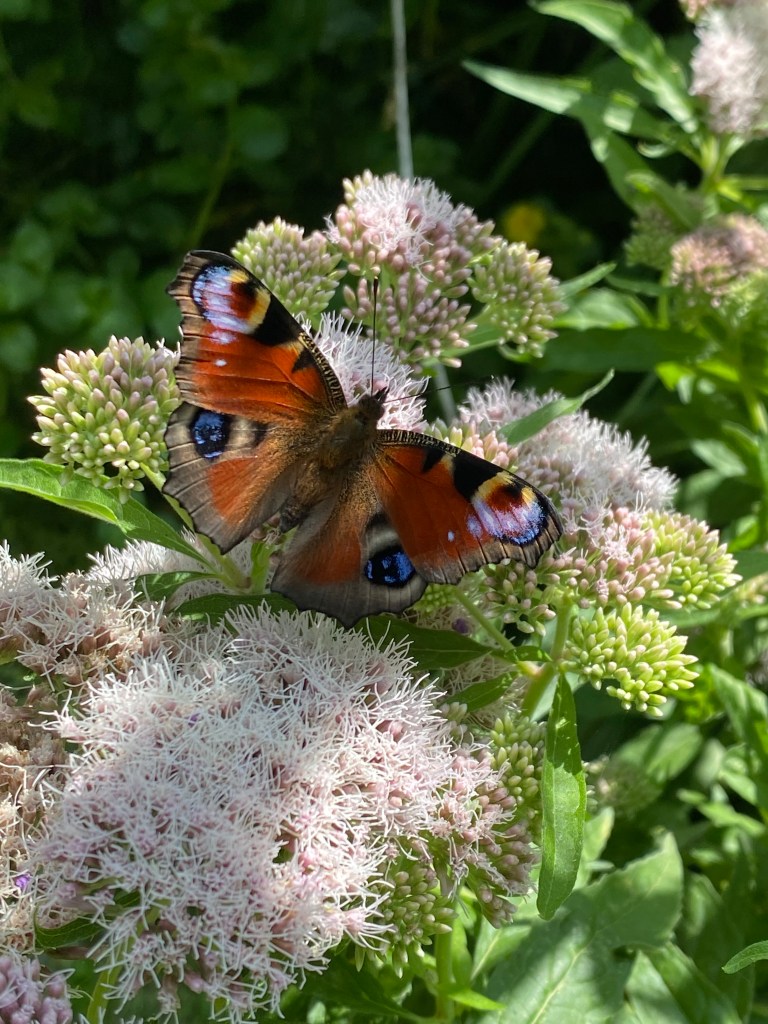
It has been a good year for butterflies, the best in a long long time. Gatekeepers flutter clumsily in the damp grass, trying to warm up and fly. By the time I make it to the first big clump of thistles I’m already warm, and some peacock butterflies are too, fluttering about the flowers, many of which have turned to seed. The breeze picks them up and blows them over the field. One day these fields will really swarm with butterflies as the thistles spread.
There’s a huge old fallen Poplar, it fell 25 years ago and hasn’t missed a beat. The branches that were side shoots are now trunks thicker than my waist. It’s a perfect place to sit and have my first coffee if I’m out early in the morning.
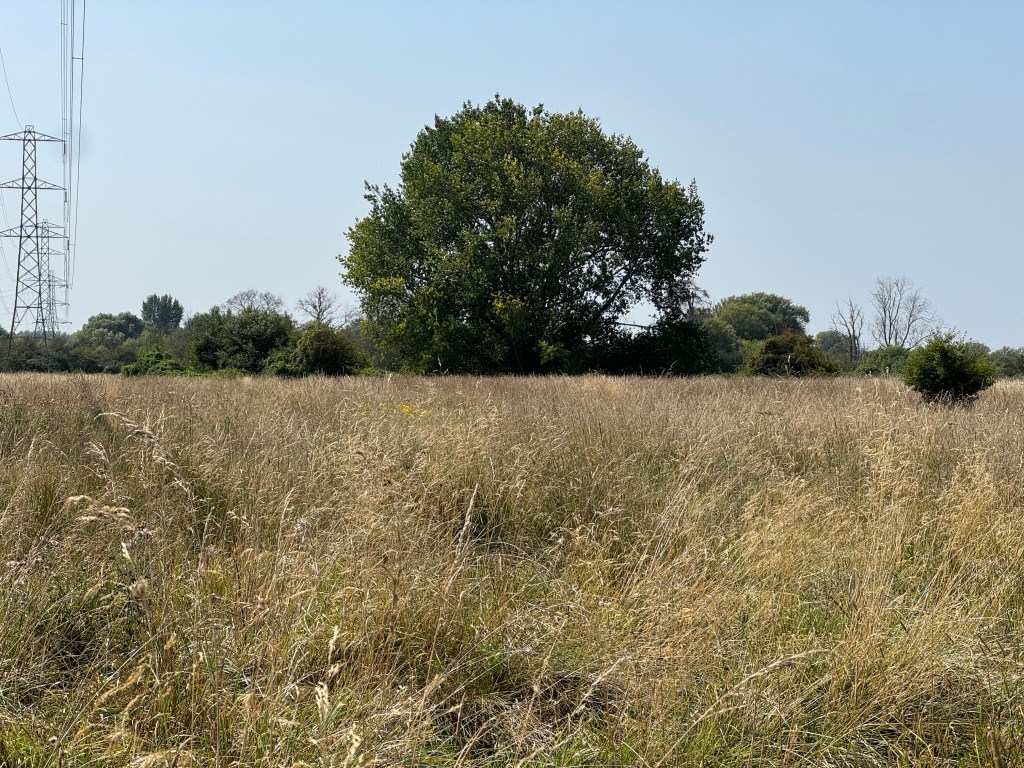
I’m grateful when I reach footpath 6, the old path across the marsh. It’s well used and some of it has been mown so it’s easy walking. I scan the fields looking through my bins.
Disappointing today, there aren’t many birds here that I can see, looking over the sea of Reed grass. A few black headed gulls and some Stock doves fly over.
There’s a lot of sound though, crickets chirp, bees buzz, a wren scolds me (or the dog) so we move a bit. In the corner of the field with the occasional little willow tree springing up I see if I can find a spotted flycatcher but no luck. I cut some of these willows down in winter to take cuttings to plant elsewhere. They’re growing back perhaps even more vigorously than before. One day a flycatcher might perch on one. I hope I’m there and looking that way when it does.
I’m on the lookout for Stonechats too. They breed here sometimes but they’ve been scarce lately. Other birds will be passing through on their way south. There may be Redstarts or Whinchats or Wheatears. I’m sure I’ll see some as the year moves along, so long as I keep looking.
Over the boardwalk and toward the water works. The ugly infrastructure reminding me I’m on the edge of town. That and the noise of the distant road. It’s popular with bikers who sporadically puncture the air with their noisy exhausts. There’s a super bike shop where they gather to stock up on testosterone and convert it to adrenalin as they leave.
Walking alongside the water works is a surprising joy. Despite the narrow path and chain link fence it’s a corridor of wildflowers. There’s a grass hook stashed by the fence, which I use to trim back bits that get a bit too narrow. I’m careful to help the different more delicate flowers to proliferate.

I manage to cross the wet patch where the water works leak water, and even though my feet are still wet from the dew I try to get across on the stepping stones. I lose my balance and put my foot down just to make sure my feet don’t dry out.
The marsh itself, the open water, has a few black headed gulls and a young water rail emerges for a fleeting glimpse of a Marshian across the water. It’s the start of the autumn migration. Birds that have spent the summer raising young much further north, and will spend the winter much further south. On their way they might stop for a break. Who know what stops there when nobody is looking.
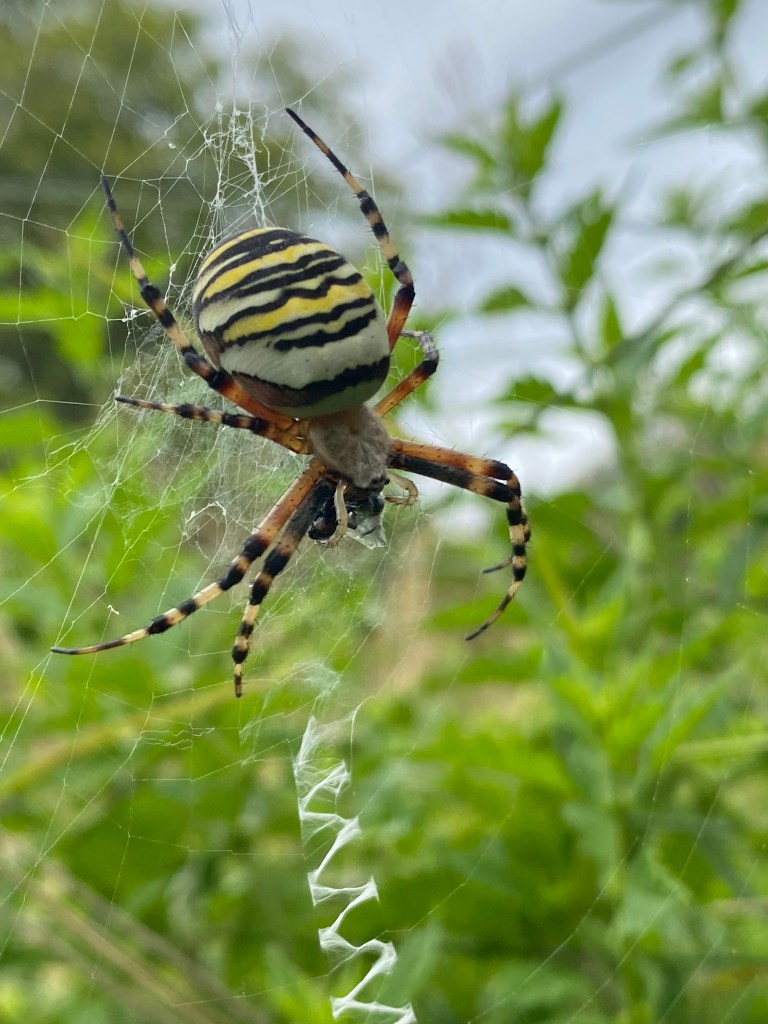
I search the grass for wasp spiders, a new arrival on the marsh, and I find one one it’s distinctive web with it’s strange little zig zag weaving.
Then along Marshian way, surprisingly quiet given the adjacent dual carriageway, but for the sound of the horns of impatient drivers trying to get ahead through the single lane roadworks. I see how many willows I can find. So many of those that we planted in April are thriving. This will be a woodland soon. I bump into another Marshian and we have a bit of a natter.
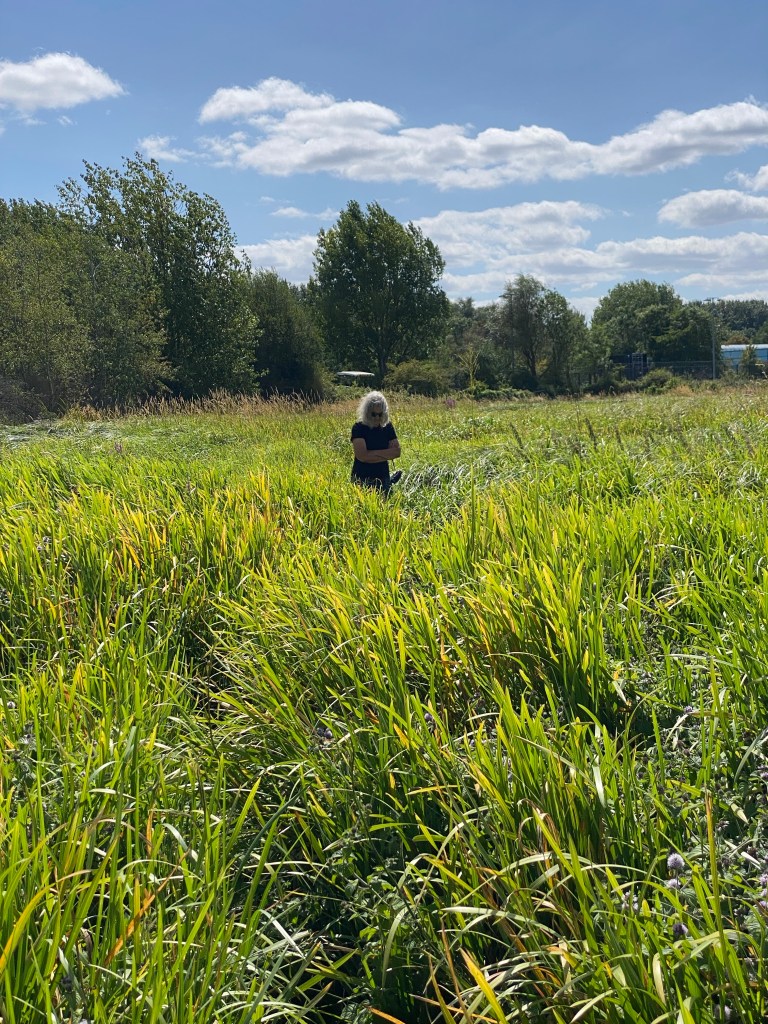
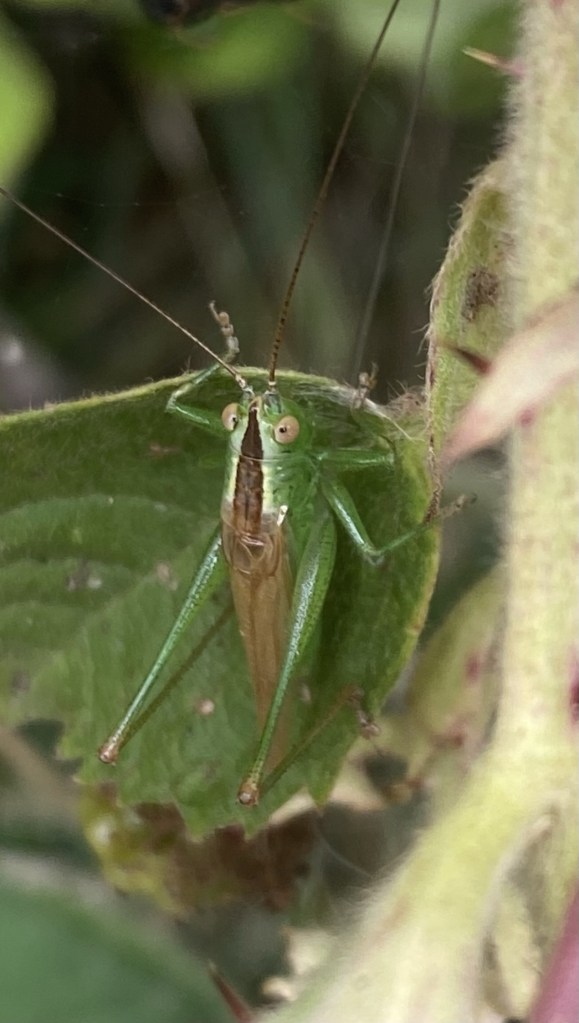
There are crickets leaping away as I wade through chest high grass, and I trim one or two bits with the grass hooks so the path gets imperceptibly wider each time.
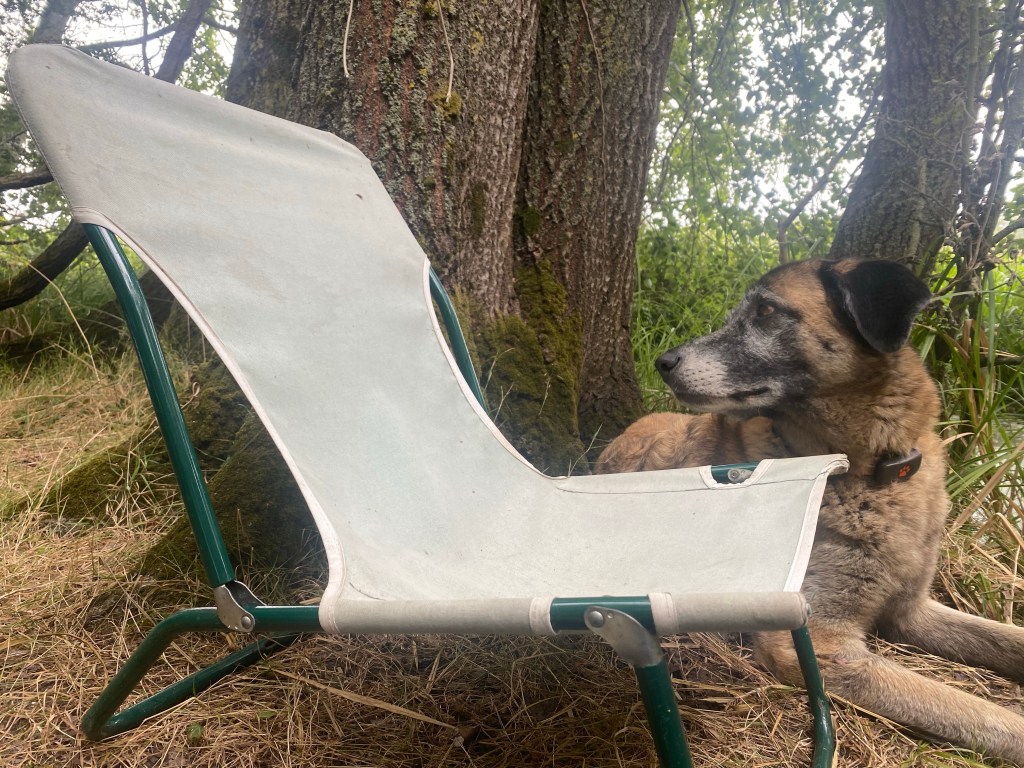
At Prosecco point I pull out the camping chair from under the log where it hides, and hide the grass hook for next time. I just have to remember to go around in the opposite direction.
I while away half an hour and watch Common Darters and Southern hawkers. The pool here is popular with dragonflies. I get to watch a female laying eggs whilst perched on a fallen branch in the margins.
As I leave a frog hops into the sedges, and stares at me as I try to take its picture. It hopped away a split second before I pressed the button.

It’s only a short walk from here to the railway line, and I leave the rustling white poplars and meander through the mint. There are little poplar saplings springing up all around, before I walk into the dense growth of still more poplars in front of the depot.
This grating eyesore will soon be screened by a dense belt of trees. I thought maybe I could plant some willows here in the autumn.
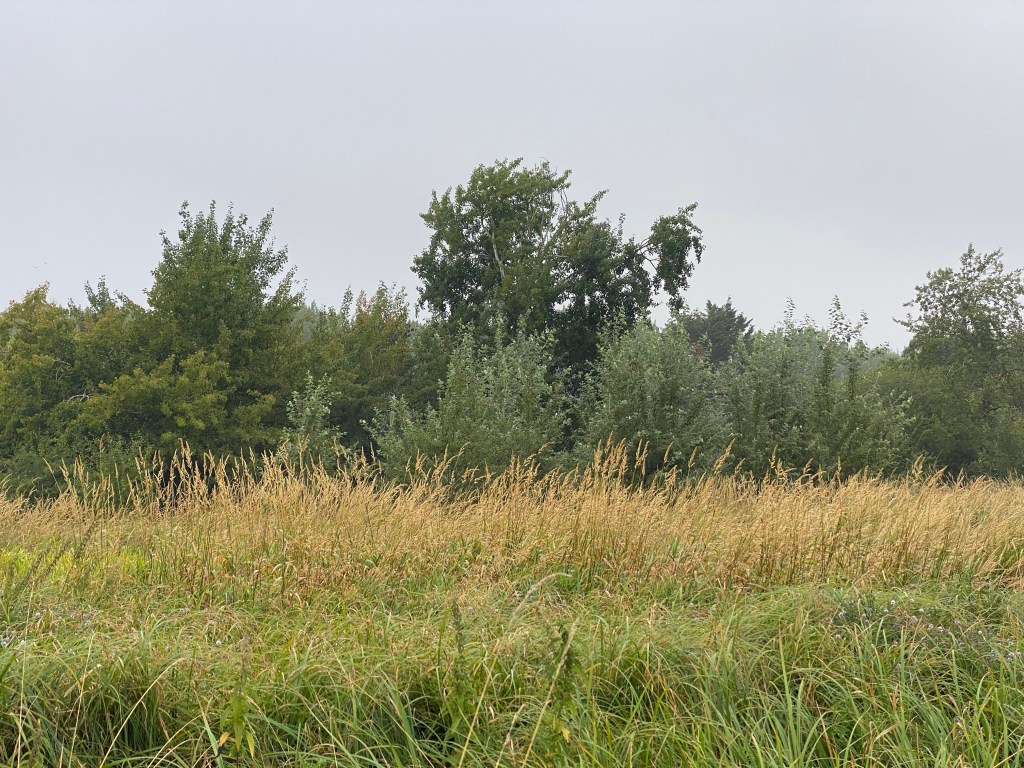
When the area was grazed there were a handful of old wild looking White Poplars. Now the grazing has stopped their extensive roots have sent out suckers. They are coming to dominate the landscape in this corner of the marsh. As the first suckers have grown into small trees their root system has spread and yet more suckers spring up. If we’re patient they’ll screen the depot for us!
it’s quite hot now, but noticeably cooler under the trees. The sallows that germinated from seed blown onto the old railway line are already growing old and falling. When I first walked this way they were little seedlings. Now they’re decrepit and their branches fall over the path.

I have to duck under them, it’s a challenge to bend down low enough to pass beneath them with my pack on my back, but it’s a useful challenge. One day my back won’t bend that far. If I keep doing it that day gets pushed further into the future.
Now it’s a plain walk more or less straight home. I call the dogs to heel and they trot along quietly behind. We stop and eat blackberries, pay respects to a departed friend memorialised in the tree she crashed into 25 years ago

She moved away and farmed in Sweden, and has passed on, but every time I pass that tree I remember her. Her story is for another time.
For now I take the well worn route back to my house. I collect a handful of the golden plums to go with my breakfast, which I think I’ve earnt.
 Rural Reading